


Dishwasher Leaving White Residue On Dishes — How to Fix
Same-day appliance repair from a local team — 18 factory-trained technicians, 4.8★ across 1,373 customer reviews. The $59 service call is free if you proceed with the repair, and every job is backed by a parts warranty up to 10 years plus a 90-day labor warranty.
Request service
You unloaded the dishwasher this morning and every glass looks like it went through a dust storm. A chalky film coats the wine glasses, the silverware has cloudy streaks running down each tine, and the inside of your favorite mug feels gritty when you run a thumb across it. You wipe one with a dish towel and the residue smears, then comes back the next cycle.
White residue on dishes is one of those problems that gets blamed on the dishwasher when the dishwasher is usually fine. Nine times out of ten, it’s water chemistry or detergent dosing. The remaining ten percent is a real mechanical failure, and that part is worth diagnosing carefully.
Test What Kind of Residue You’re Dealing With
Before you change anything, figure out which of two enemies you’re fighting.
Pull a clean, dry glass out of the cabinet. Run it under cool tap water for five seconds. If a faint white film appears as the water dries, your tap water has high mineral content (calcium and magnesium carbonate). That’s hard-water spotting, and it shows up on dishes whether your dishwasher is working perfectly or not.
Now take a dish from the dishwasher with visible residue and pour a teaspoon of white vinegar on it. Wait one minute. If the residue dissolves and the dish goes clear, you’ve confirmed hard water or detergent buildup, both of which are alkaline and get neutralized by acid. If the residue doesn’t budge, you’ve got something else going on, possibly etched glass (permanent damage) or a food/grease deposit.
That five-minute test saves you from replacing a perfectly good dishwasher.
South Florida Water Is Harder Than Most People Think
Miami-Dade tap water runs around 200 to 280 mg/L of total dissolved solids depending on the time of year. Broward sits in the same range. By the technical definition, that’s moderately hard. Out of the tap it tastes fine and shows no obvious problems, but inside a dishwasher heated to 140 F, the calcium drops out of solution and bonds to whatever surface is around. Glass, stainless, plastic, the inside of the dishwasher itself.
That’s why your fancy new Bosch 800 series with three racks still produces cloudy dishes when no one is doing anything wrong. The water is the issue.
Two fixes work without buying new equipment:
-
Rinse aid in every load. Most people skip this. The rinse aid dispenser is the little flap next to the detergent door, and it injects a surfactant during the final rinse that breaks the water’s surface tension. Water sheets off the dish instead of beading and drying in spots. Finish Jet-Dry and Cascade Rinse Aid both work. Refill the dispenser every two to three weeks.
-
Citric acid run. Once a month, pour a cup of plain white vinegar into a coffee mug, set it upright on the top rack, and run an empty hot cycle. This strips calcium off the spray arms, the heating element, and the inside walls. Works on every brand: Whirlpool, KitchenAid, Bosch, GE, LG, Frigidaire, Samsung.
Detergent Dosing and Brand
The shift from powder to pods made a lot of people lazy about dosing. A pod is a fixed amount of detergent. If you have hard water and run a heavy soil cycle, one pod often isn’t enough. The leftover food redistributes, the alkaline detergent doesn’t fully rinse, and you get a streaky white film that looks like mineral spotting but is actually detergent residue.
Two options. Use a powder or gel detergent and adjust the amount up by 25% for hard water (most brands have hard-water dosing on the label). Or run a pod plus a small scoop of booster, like Lemi Shine or Finish Booster. Lemi Shine is essentially powdered citric acid and works well in moderately hard South Florida water.
Avoid no-rinse-needed detergents on a dishwasher that has any age on it. They leave more residue than traditional formulas.
When the Dishwasher Itself Is the Problem
Now the mechanical side. If you’ve corrected the water and detergent and the residue persists, the dishwasher isn’t doing its job. Three parts are usually the culprit.
The water inlet valve. This is the solenoid that lets fresh water into the tub. On Whirlpool and KitchenAid units (parts in the W10872255 family), the valve restricts as it ages and lets in less water per fill. Less water means higher detergent concentration relative to fluid, which means more residue. You can confirm by listening to the fill phase. A healthy fill takes 70 to 90 seconds with a steady rushing sound. A starved fill takes 30 to 40 seconds and the spray arms don’t get enough pressure to actually clean.
The spray arms. Pull the lower arm out (usually a single twist-off cap) and hold it up to a light. Every nozzle hole should be open and clear. Calcium clogs them, especially the smaller fan-out holes on the upper rack arm. Soak both arms in a 50/50 vinegar-water bath for an hour, then poke each hole with a toothpick. Reinstall.
The heating element. On a dishwasher set to heated dry or high-temp wash, the element brings the rinse water up past 140 F so the detergent activates properly. If the element has failed (open winding, no continuity on a multimeter), the wash runs cold, detergent doesn’t dissolve fully, and you get gritty residue at the bottom of cups and bowls.
The Filter People Forget About
Most modern dishwashers (Bosch from 2010 on, every Whirlpool and KitchenAid post-2012, all GE Profile models) have a manual filter at the bottom of the tub. Twist out the cylindrical filter, lift the flat mesh underneath, rinse both under hot tap water with a soft brush.
If you’ve never done this and your dishwasher is over two years old, prepare for what you’ll find. Coffee grounds, lentil hulls, broken pasta fragments, and a film of cooked-on grease are all normal. That gunk is what gets sprayed back onto your dishes during the wash, and it can absolutely cause residue and a faint food smell.
Clean the filter monthly. Five minutes, zero parts cost.
Hurricane Season Power Quirks
A small thing worth flagging because we see it every September. After a power surge or extended outage, some dishwasher control boards (Samsung DW80 series, LG LDF series) lose calibration on cycle timing. The wash phase shortens, the rinse phase shortens, and dishes come out with more residue than before the storm. A factory reset (hold the start button for ten seconds with the door open on most models) usually restores normal cycle length.
If symptoms started right after a storm, try the reset before anything else.
When to Call
If you’ve descaled, dosed correctly, cleaned the filter, and verified the spray arms and you’re still pulling cloudy dishes out, the inlet valve or heating element is probably gone. Both are repairable for under $200 in parts plus labor on most brands. Berne Appliance Repair carries common inlet valves and heating elements for Whirlpool, KitchenAid, Bosch, GE, Maytag, and LG on the truck, so most jobs finish in a single visit.
Call (754) 345-4515 or book a same-day window through our dishwasher repair page. $59 service call, waived when you proceed with the repair. We serve all of Miami-Dade and Broward. Aventura residents can use our dishwasher repair in Aventura page for neighborhood scheduling, and we also cover appliance repair in Bal Harbour and surrounding coastal cities.
One last thing. If your glasses have a permanent cloudy look that doesn’t dissolve with vinegar, that’s etching, and it’s not reversible. It comes from overdosing detergent in soft-water conditions, which isn’t usually a South Florida problem, but it can happen if you installed a water softener and didn’t dial back the detergent. Throw the etched glasses out, fix the dosing, and protect the new ones.
Benefits of working with us

18 repair
technicians

discount
available

29,000+ services
completed

11 years
in business

available by
appointment

consultations
available

About us
Berne Appliance Repair has kept Miami and South Florida homes running for 11 years. Our team of 18 factory-trained technicians has completed more than 29,000 service calls, repairing refrigerators, washers, dryers, ovens, ranges, dishwashers and more for families and small businesses across the region.
We earned a 4.79-star rating from 1,373 reviews by showing up on time, diagnosing honestly, and fixing it right the first time. Same-day appointments are available, and every repair is backed by experienced people who treat your home with respect.
What can we do for you?
Dryer repair
Our 18 technicians dispatch same-day across South Florida and the Gulf Coast.
Parts on the truck, written warranty, service call applied to the repair.
Washer repair
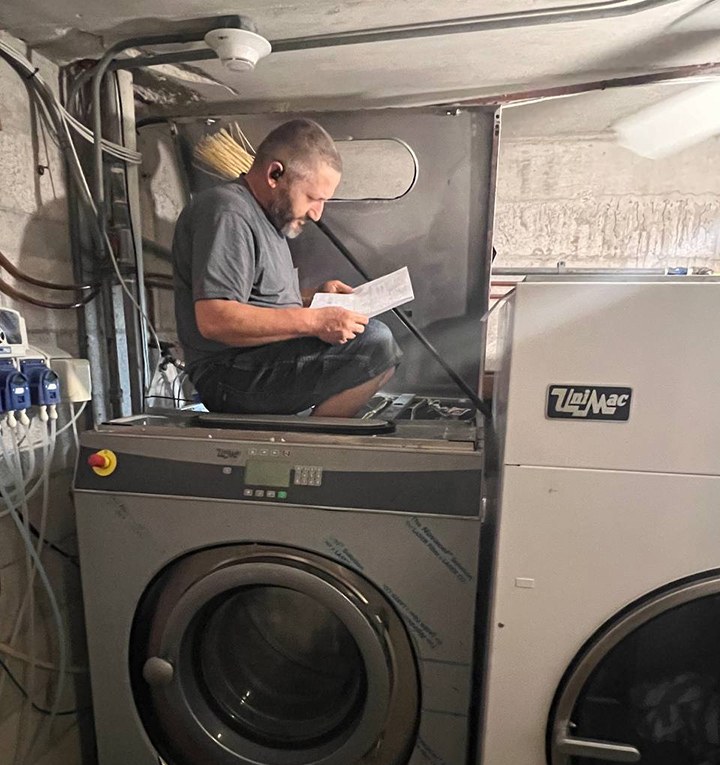
Washer not draining, not spinning, or stopping mid-cycle? Front-loaders and stacked condo units are daily work for our 18 technicians.
Drum bearings, pumps and shock-absorber kits for Samsung, LG and Whirlpool ride on the truck — most washer repairs close on the first visit, backed by our parts warranty (up to 10 years) and a 90-day labor warranty.
Microwave repair
Microwave running but not heating, sparking, or tripping the breaker? Built-in and over-the-range models are usually worth repairing — replacement means cabinetry work.
We test magnetrons, diodes and door switches in one visit; the $59 service call is free if you proceed with the repair.
Dishwasher repair
Standing water in the bottom, dishes coming out dirty, or an error code that will not clear? We run dishwasher calls across Miami-Dade, Broward and Palm Beach every day.
You approve a written quote before any work starts, and every repair carries a tiered parts warranty — up to 10 years on welds, 2 years mechanical, 1 year electronics — plus a 90-day labor warranty.

Range, stove, cooktop and oven repair
Burner not lighting, oven running cold, or an induction cooktop that stopped recognizing pans? We repair gas and electric ranges, wall ovens and cooktops every week.
Igniters, bake elements and control boards for Whirlpool, GE, Samsung and LG are stocked on the truck — the $59 diagnostic is waived when you proceed with the repair.
Refrigerators, wine coolers, ice-machines repairs
Refrigerator not cooling, ice maker gone quiet, or wine cooler running warm? No-cool calls get priority routing — in South Florida heat a full fridge cannot wait.
Parts on the truck, written warranty, service call applied to the repair.
Equipment we service:












Do you need help with your firm's machines?
With extensive experience in serving businesses, we offer fast and cost-effective solutions for a variety of technical machines – from washers and refrigerators to dryers and ovens. Trust us for efficient service tailored to your business needs.
Request service
Ronald l. (Hialeah, FL)
texted thru yelp app and got a reponse with 10 min. pricing for diagnostics was very reasonable. repair pricing was in line with other companies. have to admit guy was knowledgeable and when he left everything was working good. wife was extremely happy as she could not dry our clothes.
definitely recommend this company as very reliable and fast to get out to fix my problem
Jason O. (North Miami Beach, FL)
We recently had Berne Appliance Repair service our fridge. The technician was great and did an amazing job defrosting and cleaning the internal parts of the fridge. It's working like brand new!
I would recommend then to anyone that needs appliance repairs.
Vincent (Fort Lauderdale, FL)
Needed to have a new cooktop installed . spoke with Eugene and he was able to schedule a install time the very next day. The Technician Is-Mael came to install the appliance very professional, A few cabinet modification were needed to install the new unit but was completed with no issues.