


Hurricane Refrigerator Survival Guide — Outage to Restart
Same-day appliance repair from a local team — 19 factory-trained technicians, 4.8★ across 1,301 customer reviews. The $59 service call is free if you proceed with the repair, and every job is backed by a parts warranty up to 10 years plus a 90-day labor warranty. $59 covers the visit and diagnosis and is credited to the repair if you go ahead. If you don't, it's the only charge.
Request service
Of all the appliances in a Florida household, the refrigerator is the one most affected by a hurricane and the one most homeowners get wrong. Open it too often, lose the food. Wait too long to start it back up, you risk the compressor. Plug it in too fast after restoration, you fry the main board. This guide is the practical sequence we walk customers through every storm season.
How Long Food Actually Keeps Once the Power Cuts
The USDA numbers are the right place to start because insurance companies and the Florida Department of Health both quote them.
- Refrigerator section, doors closed: safe for 4 hours
- Full freezer, doors closed: safe for 48 hours
- Half-full freezer, doors closed: safe for 24 hours
“Safe” here means food stays at or below 40 degrees Fahrenheit. Above that, bacteria multiply quickly enough that perishables become a food-poisoning risk regardless of how they look or smell. Meat, dairy, eggs, leftovers, cut fruit, and prepared salads are all in this zone. The danger temperature is the same whether your fridge is a $400 Frigidaire or a $14,000 Sub-Zero 648PRO.
These numbers assume the door stays shut. Every opening costs ten to fifteen minutes of reserve. Five openings turn a 4-hour fridge into a 3-hour fridge.
How to Read the Temperature Without Opening the Door
Buy a refrigerator-freezer thermometer with a wired external probe. The probe goes inside the fridge, the display sits on the counter. Twenty dollars at Home Depot, sold all year, in stock during storm season because most homeowners forget to buy one. With this in place you know whether your food is still safe without opening the door and dumping the cold.
If you do not have a probe thermometer, the next best thing is the frozen-quarter trick. Fill a small cup three-quarters with water, freeze it solid, place a quarter on top of the ice, and put the cup in the freezer. When you come back, if the quarter is still on top, the freezer never thawed. If the quarter has sunk halfway, the freezer thawed and refroze, and some of your food crossed 40 degrees. If the quarter is at the bottom, everything in the freezer needs to be evaluated for safety.
What to Throw, What to Keep
Once the power has been out long enough that fridge temperature climbs above 40 degrees Fahrenheit, throw out:
- All raw and cooked meat, poultry, and seafood
- Eggs (whole and beaten), egg dishes, soft cheeses
- Milk, cream, yogurt, sour cream, buttermilk
- Leftovers, casseroles, soups, stews
- Cut fruit and vegetables, cooked pasta, cooked rice, cooked beans
- Open mayonnaise, opened salsa, opened salad dressings
- Fresh juice, smoothies, infant formula
Safe to keep at fridge-temperature-failure:
- Hard cheeses (cheddar, parmesan), butter and margarine
- Whole intact fruits and vegetables, raw uncut
- Condiments — ketchup, mustard, peanut butter, jelly, vinegar pickles
- Bread, rolls, bagels, tortillas
- Coffee, dry goods that happened to be in the fridge
For the freezer, the rule is “still has ice crystals or temperature 40 F or below” — refreeze. If thawed completely and warmer than 40, treat the same as fridge food and toss.
The cost of food spoilage is real but the cost of food poisoning during a hurricane recovery — when emergency rooms are overwhelmed and the roads may not be passable — is much worse. When in doubt, throw it out.
Generator Power Priorities for a Refrigerator
You have a generator running. The fridge is one of several things asking for power. Here is how to think about it.
Most modern refrigerators draw 600 to 800 watts at compressor startup and settle at 100 to 200 watts running. Sub-Zero built-ins with dual sealed systems can hit 900 to 1,100 watts when both compressors cycle together. Older single-compressor units run closer to 150 watts steady-state.
A 2,000-watt inverter generator can run a refrigerator continuously while also running lights and a phone charger, with margin for cycling. A 3,500-watt inverter can run the fridge, a chest freezer, a ceiling fan, and a window AC together if you sequence the startups. A 5,500-watt portable can handle most of the kitchen but watch the well pump if you have one.
Connect the fridge to the generator with a heavy-gauge extension cord, 12-gauge minimum for runs under fifty feet, 10-gauge for longer runs. Undersized cords drop voltage at the appliance and that low voltage is what damages compressor motors. We see this every storm season — homeowners run a 16-gauge orange cord from a generator in the garage to a refrigerator in the kitchen and wonder why the compressor never starts properly.
If your fridge uses an inverter compressor (Samsung Family Hub, LG InstaView with Linear, current Sub-Zero, current Miele), check whether your generator is rated for sensitive electronics. The inverter-compressor models are intolerant of dirty power. An inverter generator is required. If you only have a contractor open-frame generator, you may need to choose between protecting the fridge and using the generator at all.
Post-Storm Refrigerator Restart — The Right Way
Power has come back. You waited the recommended thirty minutes for grid stabilization. Now you are restarting the refrigerator.
Step one: visual inspection. Pull the fridge out from the wall a foot. Look at the floor for water — any standing puddle or moisture means flooding occurred. Check the back of the unit for any waterline staining. Check the cord and plug for discoloration. If anything looks wrong, do not plug it in until a technician has looked at it.
Step two: smell test. Open the fridge and freezer doors. If you smell rotting meat, you know what you are dealing with. Empty the unit completely, even items that look fine. The smell will permeate. Wipe interior surfaces with a baking-soda-and-water solution, leave the doors propped open for thirty minutes, then continue.
Step three: plug in, empty. With the unit empty, plug it in. Listen. You should hear a soft hum within a minute or two as the compressor engages. You should hear or feel the evaporator fan moving air through the back vents inside the freezer. Set both compartments to mid-range, not coldest — you do not want to overload the compressor on its weakest startup.
Step four: let it cool down empty for an hour. After sixty minutes, the freezer should feel cold to the touch, the fridge should feel noticeably cooler than room temperature. If neither has dropped, you have a problem worth diagnosing — call us.
Step five: load slowly. Put room-temperature items in first — condiments, drinks, anything from the cooler that is still at fridge temperature. Wait another two hours, then add the rest. The reason for the staged loading is that warm food is a heat load. The compressor has to do extra work to pull that heat out. After a hurricane, many compressors are already marginal. Pushing them to do extra work on day one is what kills them in week three.
The Sub-Zero Special Case
Sub-Zero built-ins (601, 632, 648, 685, current 700-series) have two completely separate sealed systems. This is normally an advantage — you can lose one and still have one — but during hurricane recovery it means double the exposure to surge damage and double the cost when something fails. The fridge-section compressor and the freezer-section compressor each have their own control board and their own inverter. We routinely see Sub-Zero units in Bal Harbour, Sunny Isles, Key Biscayne, and Coconut Grove come in two weeks after a storm with one section working and one section failed.
If you have a Sub-Zero, the slow-start protocol is non-negotiable. Plug it in, let both sections run empty for two hours minimum before loading, and watch both compartments hit target temperature before you trust the unit. A failed Sub-Zero sealed-system repair runs $1,800 to $3,400 depending on which section and which generation. Slow-starting costs you nothing.
If Your Fridge Does Not Cool After Restart
You did everything right. The unit will not get cold. Common storm-related causes, in the order we encounter them:
- Surge-damaged main control board. Lights work, display works, but the compressor never engages. Symptom is silence inside the cabinet, no hum. Replacement part is brand-specific, ranges $180 to $450 plus labor
- Surge-damaged inverter board (inverter-compressor models). Similar symptoms but you might hear the compressor try to start and fail. Common on Samsung, LG, Whirlpool with linear compressor. Part runs $200 to $600
- Failed start relay or capacitor. Common on older units (Frigidaire, GE, Whirlpool from 2010 and earlier). You hear a click every few minutes — that is the unit trying to start. Cheap fix, $40 to $90 in parts plus labor
- Compressor itself failed. Worst case. Often shows up as the unit was working when you left and not working when you got back, with no surge involvement. On a unit over eight years old, the math usually points to replacement
Related Reading
- Hurricane Prep — Appliance Checklist for South Florida
- Hurricane Power Surge Damage to Refrigerator Control Boards
- Storm-Damaged Appliance Insurance Claim Guide
- Refrigerator Repair Service
Storm damage? Call (754) 345-4515 — same-day across Miami-Dade, Broward, and Palm Beach.
Benefits of working with us

19 repair
technicians

discount
available

31,044+ services
completed

11 years
in business

available by
appointment

consultations
available

About us
Berne Appliance Repair has kept Miami and South Florida homes running for 11 years. Our team of 19 factory-trained technicians has completed more than 31,044+ service calls, repairing refrigerators, washers, dryers, ovens, ranges, dishwashers and more for families and small businesses across the region.
We earned a 4.79-star rating from 1,301 reviews by showing up on time, diagnosing honestly, and fixing it right the first time. Same-day appointments are available, and every repair is backed by experienced people who treat your home with respect.
What can we do for you?
Dryer repair
Our 19 technicians dispatch same-day across South Florida and the Gulf Coast.
Parts on the truck, written warranty, service call applied to the repair.
Washer repair
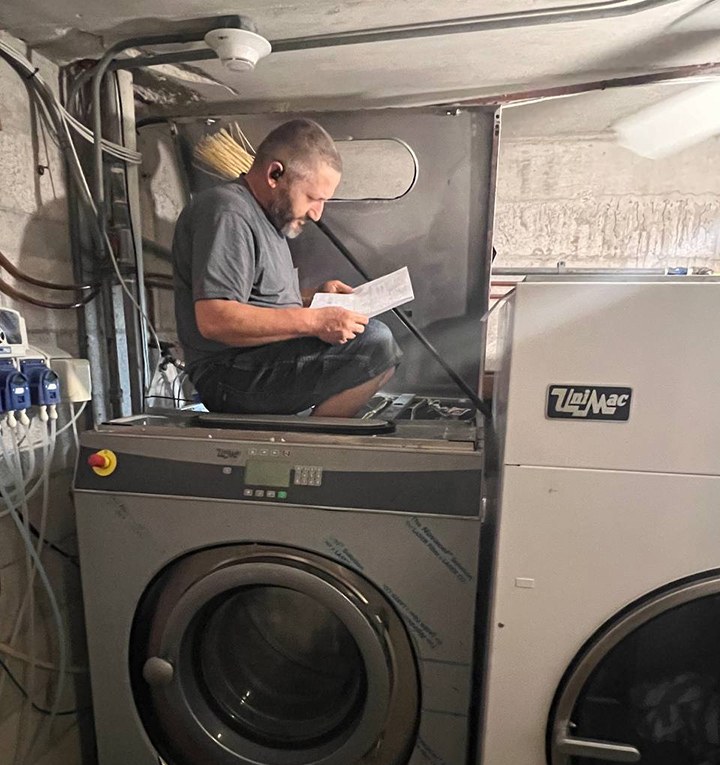
Washer not draining, not spinning, or stopping mid-cycle? Front-loaders and stacked condo units are daily work for our 19 technicians.
Drum bearings, pumps and shock-absorber kits for Samsung, LG and Whirlpool ride on the truck — most washer repairs close on the first visit, backed by our parts warranty (up to 10 years) and a 90-day labor warranty.
Microwave repair
Microwave running but not heating, sparking, or tripping the breaker? Built-in and over-the-range models are usually worth repairing — replacement means cabinetry work.
We test magnetrons, diodes and door switches in one visit; the $59 service call is free if you proceed with the repair.
Dishwasher repair
Standing water in the bottom, dishes coming out dirty, or an error code that will not clear? We run dishwasher calls across Miami-Dade, Broward and Palm Beach every day.
You approve a written quote before any work starts, and every repair carries a tiered parts warranty — up to 10 years on welds, 2 years mechanical, 1 year electronics — plus a 90-day labor warranty.

Range, stove, cooktop and oven repair
Burner not lighting, oven running cold, or an induction cooktop that stopped recognizing pans? We repair gas and electric ranges, wall ovens and cooktops every week.
Igniters, bake elements and control boards for Whirlpool, GE, Samsung and LG are stocked on the truck — the $59 diagnostic is waived when you proceed with the repair.
Refrigerators, wine coolers, ice-machines repairs
Refrigerator not cooling, ice maker gone quiet, or wine cooler running warm? No-cool calls get priority routing — in South Florida heat a full fridge cannot wait.
Parts on the truck, written warranty, service call applied to the repair.

Equipment we service:












Do you need help with your firm's machines?
We run the commercial side too: restaurant refrigeration, ice machines, warewashers, cooking lines and on-premise laundry across Miami-Dade, Broward and Palm Beach. Commercial dispatch is $89, COI on request, and kitchens that are open that morning go first. Details at berne-commercial.com.
Request service
Ronald l. (Hialeah, FL)
texted thru yelp app and got a reponse with 10 min. pricing for diagnostics was very reasonable. repair pricing was in line with other companies. have to admit guy was knowledgeable and when he left everything was working good. wife was extremely happy as she could not dry our clothes.
definitely recommend this company as very reliable and fast to get out to fix my problem
Jason O. (North Miami Beach, FL)
We recently had Berne Appliance Repair service our fridge. The technician was great and did an amazing job defrosting and cleaning the internal parts of the fridge. It's working like brand new!
I would recommend then to anyone that needs appliance repairs.
Vincent (Fort Lauderdale, FL)
Needed to have a new cooktop installed . spoke with Eugene and he was able to schedule a install time the very next day. The Technician Is-Mael came to install the appliance very professional, A few cabinet modification were needed to install the new unit but was completed with no issues.